
We have our own problems for sure and they are not trivial, but for now, our economy is in not too bad a shape, our politics is as personality-driven and authoritarian as that of most countries in the world. We must make the best of what we have and not be excessively unhappy looking at the grass on the other side of the septic tank which may not be greener after all!, observes Shreekant Sambrani.

'Balakot and Pulwama will definitely help the BJP, but it will still not help them to create a 2014 like situation or go beyond that.'
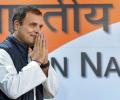
The campaign's main theme song 'Main hi toh Hindustan hoon' has been penned by Javed Akhtar.

In the second and final part of his column, Col Anil Athale says the fight between forces of Indian nationalism and Macaulayism aided and abetted by West is going to be long, hard and dirty. The outcome will decide whether India becomes a superpower or continues to wallow in the swamp of underdevelopment.

'She really doesn't care if she is called heartless.' 'For her, the job needs to be done. That's all that matters.'

December 3, 2021 marks 50 years since the beginning of the 1971 War which ended in a decisive military victory for India and the liberation of Bangladesh. Most analysts of the 1971 War agree that the IV Corps dash across the mighty Meghna river led by the brilliant General Sagat Singh was the turning point in the war, recalls military historian Colonel Anil A Athale (retd).

True, Azam Khan is being targeted rather disproportionately and also because of his Muslim identity. That must be protested and resisted. But to say that he is a big messiah, and his profit-making educational enterprise is an issue concerning all Muslims of India, is absolutely unjustified, assert Mohammad Sajjad and Md Mohammad Zeeshan Ahmad.

'When we say we want to increase pension participation, do we want to increase participation through the savings route?' 'Or do we want people to save in specific pension products?' asks Renuka Sane.

The perception about JNU being 'radical' is one that is as old as JNU itself. But the university is more than just that. At its heart, its campus is a mosaic of ideologies that allow its students to breathe politically.

How should one billion Indians, for whom deprivation has become an inescapable way of life, join us in celebrating 75 years of Independence? And where do we go from here? asks Kalyan Singhal.

A consensus builder, Jaitley was regarded by some as Modi's original 'Chanakya'.

'The autonomy of essential institutions is clearly under question as the Modi government seeks to influence them politically.' 'The credibility of institutions such as the EC, the CBI, the CVC, the UPSC, the RBI, media, and universities, has been compromised,' notes Zoya Hasan, the distinguished political thinker.

'Both the governor and the President enjoy an enormous array of 'grey' powers.' 'All parties criticise these when in the Opposition. But why does no government dismantle them when these parties come to power?' asks Aditi Phadnis.
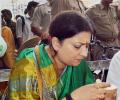
'One hopes that in his second term, Modi spends more time reading serious material even if it bores him or is against his nature,' says Aakar Patel.

If an elected government had been sworn in, Jung's tenure and the government would have been more or less co-terminus and Jung would have been just the ceremonial head of Delhi. Now, he will run Delhi, pending another round of assembly elections, says Aditi Phadnis

Many of those who have been to Covid hell and back are unable to shake off the memories of their days in hospitals, leading to worries about post-traumatic stress disorder and other anxiety related problems, including insomnia.

'If the museum in his memory inspires and instils among Brahminical British Indians an attitude of equality towards Dalits, the edifice would be worth it,' reports Ashis Ray.

If one were to go by the degree of clout, Jaitley was the undoubted No. 2 in the Modi government.

President Pranab Mukherjee -- rewarded as president yet not trusted enough to be prime minister.
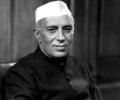
'India's first and longest-serving prime minister created -- or at the very least imagined -- a modern, democratic nation-State of the 20th century,' says Sunil Sethi.
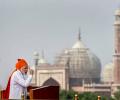
India is too diverse to be governed centrally and with a single system. The way forward is for the central government to keep the monopoly of military power and a share of national resources while the provinces must have greater autonomy, recommends Colonel Anil A Athale (retd).

Relations between an elected government of Delhi and the LG can never be cordial: It is just the way the relationship is structured.

Our generation got independence too easy, we take our freedom too lightly, we treat our country and environment like toilet paper and take the easy way out because we have no sense of pride or self worth except when it is an India-Pakistan match. We need to be broken more so that we may rise, says film director Suparn Verma.

The ruling DMK in Tamil Nadu had begun seeing Governor Ravi's decisions and actions as a part of the state BJP's non-stop criticism of its government and directed from Delhi, a view strengthened by the governor's decision to return the NEET exemption bill, points out N Sathiya Moorthy.

'The only narrative before India is what Modi and the BJP is presenting.' 'Nationalism has been taken as a serious plank by the BJP and RSS.' 'They want to keep the nationalism thing alive to make people forget the economic reality.'
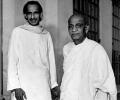
In an era when the misguided youth of today are trying to build political careers by subscribing to divisive ideologies, they need to look to independent thinking icons such as Acharya Kripalani, says Mohammad Sajjad.

One solution to India's challenges of education, employment, employability lies in state governments adopting apprenticeships on a large scale.
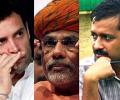
Rahul Gandhi thinks his imaginary Congress is the silver bullet; Narendra Modi thinks he himself is the silver bullet; Arvind Kejriwal seems to think that neighbourhood councils are a silver bullet. But none of them is right, says Mihir S Sharma.

Nikhat from Telengana was handed the fourth spot in the 51 kg category which already has the six-time World Champion MC Mary Kom, RSPB's Jyoti Gulia and Haryana's Ritu Grewal as other contenders.

'Like Nehru, too, Modi has found dealing with Beijing more and more difficult and has adopted an increasingly assertive approach towards managing India's northern neighbour.'

Does Mrs Donald Trump realise that her immediate predecessor, Michelle Obama, is not the only hard act to follow, wonders Kanika Datta.

'It is extremely important to take back the domain of both religion from the religious bigots and nationalism from the chauvinists, who are spreading hatred.' Sugata Bose, the Harvard historian-turned-MP, who is Netaji's great-nephew, tells Anjali Puri why it is imperative to speak up for India's students.

Indians must remember that Pakistanis hate losing to India, at war or in cricket, says Sanjeev Nayyar.

'You can't go on creating division and rhetoric of hate.' 'It comes to roost. We are seeing the first glimpses of that in the state elections.'

'Previous governments in India had reservations about working with Israel.' 'Modi has shed this tag.' 'Disengaging itself from its traditional and ideological foreign policy approach in the Middle East shall serve India's long-term interests.' Rajaram Panda explains why the significance of Modi's visit to the Jewish nation goes beyond markers like the first-ever visit to Israel by an Indian PM and 25 years of diplomatic ties.

'Their vote bank has shifted to the BJP; the Congress is yet to realise it.'

'The majority of the spread is by people coughing, or sneezing or talking loudly, in a very short distance, two metres from one another, and a mask will prevent that sort of transmission.'
Aseem Chhabra lists his favourite Indian films of 2021.
'What is forgotten but is actually as important for a society's long run success is morality.' 'Morals and trust are the nuts and bolts of an economy.' 'Without those you can get short run success, but not long-run development.'

'... A youth movement which could really transform our politics in a way that the existing elites don't understand.' 'The more you suppress free expression, the more people will value it.' 'The State can't suppress a young society like India where there are so many interesting new ideas emerging,' says Sunil Khilnani, whose latest book Incarnations looks at Indian history through 50 lives.
 © 2026 Rediff.com - Advertise with us - Disclaimer - Privacy Policy - Sitemap - Feedback - About us - Terms of use - Grievances